An inbound lead submits an intake form at 10:14 AM on a Tuesday. By 10:16 AM, the pipeline is silently broken.
No server crashed. No cloud status page flipped to yellow. The failure occurred inside the unmonitored void
between six disconnected SaaS subscriptions. A field name was updated in Typeform. The webhook fired a payload
that Zapier’s parser failed to validate, spitting out an unhandled 422 Unprocessable Entity. Zapier
initiated a blind retry loop, burned through the organization’s monthly task quota in forty minutes, and stopped
dispatching events altogether.
Forty-two qualified enterprise leads sat trapped in third-party memory while ClickUp stayed empty, HubSpot recorded zero new deals, and Zendesk failed to spawn onboarding tickets.
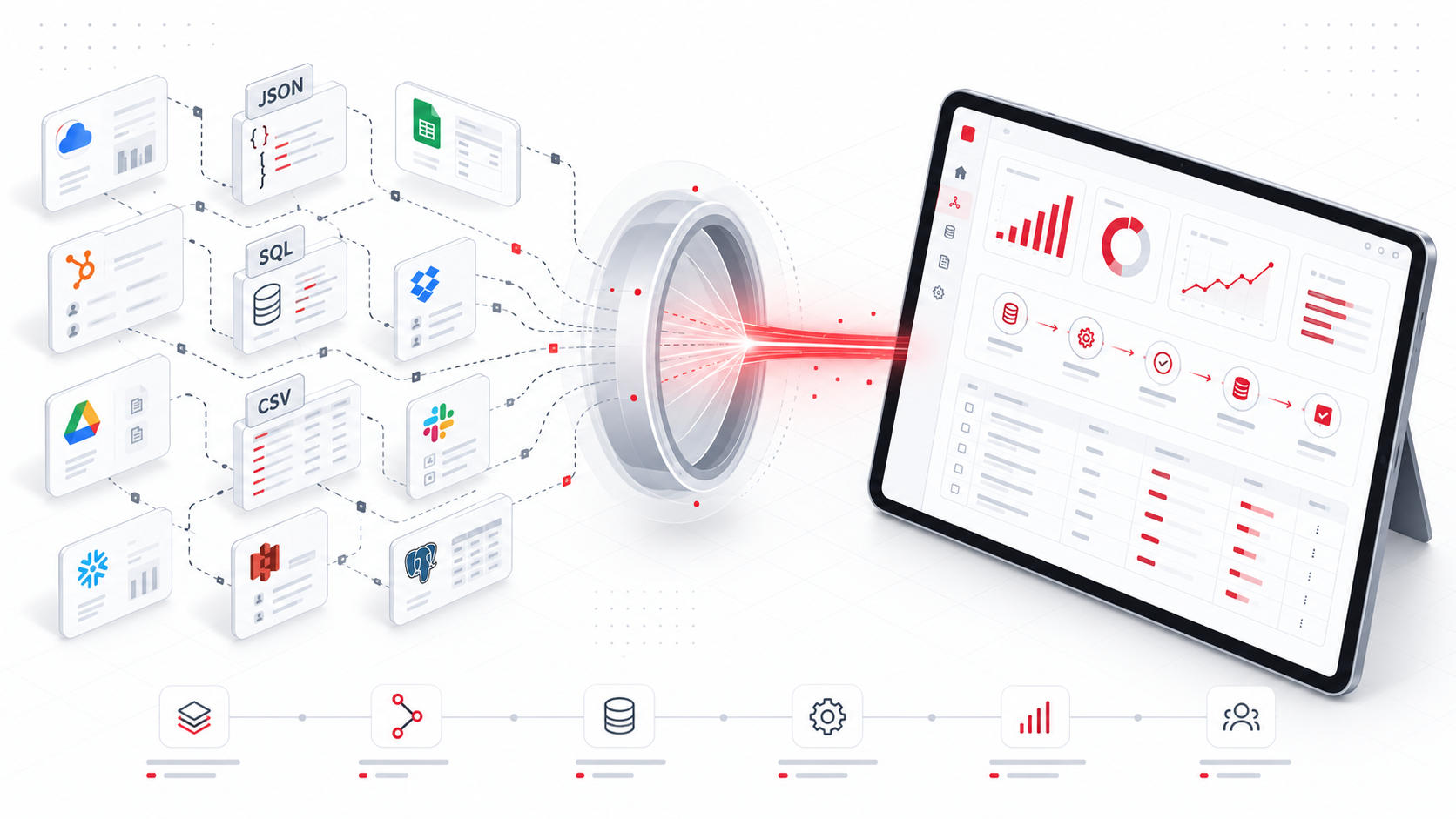
"This is the SaaS Trap. You have not bought software. You have bought six isolated databases that share no transaction boundaries, offer zero ACID guarantees across boundaries, and demand hundreds of hours of brittle middleware duct tape just to simulate eventual consistency."
The Core Dilemma: The $42k/Year Subscription Bleed
Growing companies fall into this trap because off-the-shelf tools look cheap on day one. A founder swipes a credit card for $25 to $80 per seat per month across half a dozen tools. The logic seems unassailable: avoid upfront engineering overhead, defer infrastructure management, and purchase vendor specialization.
Two years later, that same 20-person operation is paying for HubSpot ($1,200/mo), Zendesk ($1,100/mo), Zapier Enterprise ($599/mo), ClickUp ($380/mo), Slack Pro ($175/mo), and Typeform ($99/mo), plus secondary plugins to bridge sync gaps. The balance sheet bleeds $3,553 every month—an annual recurring drain of $42,636.
The financial cost is only the visible surface. The technical reality is far worse: your operational state machine is fragmented across half a dozen closed, proprietary silos.
The Unvarnished Architecture: Integration Quagmire vs. Unified Core
To understand why middleware glue invariably fails under real production load, contrast the two structural topologies side-by-side:
[Lead Ingest] ──► (Typeform)
                     │
               [Webhook Loss Zone]  <── Silent Schema Drift / 422 Rejection
                     ▼
                 (Zapier)  <────────── [HTTP 429 Rate Limits / Task Quotas]
                  │    │
         ┌────────┘    └────────┐
         ▼                      ▼
     (HubSpot)              (ClickUp)
   [State Drift]          [Desynced IDs]
         │                      │
         └─────────┬────────────┘
                   ▼
               (Zendesk)
     [Manual Human Reconciliation]
Now examine the engineering alternative: a clean, unified domain core deployed inside a private VPC where all critical business entities reside inside a single transactional boundary:
               [Unified Public API / Ingest]
                             │
                             ▼  (Single ACID Transaction Boundary)
        ┌──────────────────────────────────────────┐
        │        Transactional Domain Core         │
        │  PostgreSQL (Strict Foreign Key Rel.)    │
        │  • Accounts  • Pipelines  • Tickets      │
        └──────────────────────────────────────────┘
                             │
             ┌───────────────┴───────────────┐
             ▼                               ▼
  [Zero-Latency Internal UI]     [Transactional Outbox Pattern]
  (Role-Tailored Operational Views)          │
                                             ▼
                                  [Reliable Worker Queue]
                                             │
                                ┌────────────┴────────────┐
                                ▼                         ▼
                           (Postmark)                 (Stripe)
                       Transactional Mail         Payment Settlement
The Non-Obvious Breakdown: Where Distributed SaaS Stacks Fail Under Load
Why does Topology A inevitably break down as transaction volume scales? The issues are not cosmetic; they are structural computer science constraints:
1. The Fallacy of Distributed Transactions Over Public HTTP
When your operational pipeline spans Typeform, HubSpot, ClickUp, and Zendesk, an everyday business event—such as Lead Converts to Active Project—is an uncoordinated distributed transaction.
Off-the-shelf integration middleware attempts to orchestrate this via serialized HTTP POST requests. Public HTTP APIs provide no native two-phase commit (2PC) protocol. If the incoming payload updates HubSpot, creates an asset directory, but encounters an HTTP timeout when writing to ClickUp, the entire workflow enters a split-brain state.
There is no rollback mechanism. There are no automated compensating transactions. The customer record drifts permanently out of sync until an operations manager spends an hour cross-referencing CSV exports to identify missing state. When assessing the 5 Signs Your Business Needs a Custom CRM, this silent, structural data corruption is consistently the first breaking point.
2. The HTTP 429 Cascade and the Polling Latency Tax
Every SaaS vendor protects their multitenant infrastructure with strict, non-negotiable rate limits. HubSpot enforces burst limits per rolling 10-second window; Zendesk caps concurrent API requests based on subscription tiers; Zapier polls on staggered 1-to-15 minute schedules depending on plan level.
When an operational surge hits—a product launch, a press mention, or a bulk lead upload—the API integration
topology hits an immediate wall of HTTP 429 Too Many Requests. Critical pipeline tasks fall into
exponential backoff queues or unmonitored dead-letter bins.
In enterprise B2B pipelines, a response delayed past five minutes degrades lead conversion rates significantly compared to an immediate response. Chained SaaS integrations bake latency directly into your intake architecture. A custom operating system processes incoming requests directly into a local PostgreSQL write buffer in under 35 milliseconds, executing validation and state updates without crossing external network boundaries.
3. The Headcount Extortion Curve
The per-seat pricing model practiced by enterprise SaaS is structurally hostile to operational efficiency. When you hire an account executive or project coordinator, their marginal infrastructure cost to your business is virtually zero—a few kilobytes of storage and negligible compute cycles.
SaaS vendors tax that new hire across every layer of your stack: $120 for a CRM seat, $60 for customer support access, $25 for project tracking, and another $15 for internal communications. Your software expense scales linearly with team size, completely decoupled from actual computing resource usage.
Custom software flips this dynamic: development becomes a capitalized asset on your balance sheet that costs nearly the exact same to host for 15 employees as it does for 75. When evaluating How to Effectively Move to a Custom CRM When Your Business Is Already Running, breaking free from seat-licensing penalties is the core driver of long-term operational leverage.
4. The Context-Window Barrier for Applied AI
Running internal Large Language Model (LLM) agents or automation pipelines across six fragmented SaaS tools requires constant data extraction, transformation, vector synchronization, and third-party authentication juggling. Every tool boundary strips away relational context.
When your pipeline lives inside a unified relational database, feeding business state into an inference engine requires only a single, structured SQL query. If your product roadmap includes How to Embed AI into Your Existing CRM, establishing a unified, schema-enforced relational foundation (such as choosing PostgreSQL over NoSQL for enterprise CRM workloads) is an absolute prerequisite.
The Trade-Off Matrix
A direct architectural and financial comparison between a fragmented 6-tool SaaS stack and a unified custom core:
| Dimension | Fragmented SaaS Stack (6+ Tools) | Unified Custom Operating System |
|---|---|---|
| Blast Radius | High & Uncontained A schema modification or expired API token in one tool breaks downstream workflows silently. |
Isolated &
Typed Domain boundaries are enforced by database foreign keys and typed internal contracts. |
| P99 / Latency Tax | Minutes Polling delays (1–15 min) combined with serialized third-party network round-trips. |
Sub-50ms Direct in-memory and local database operations executing within a single VPC. |
| Operational Cognitive Load | Severe Fatigue Employees navigate 4–6 conflicting UIs, inconsistent search patterns, and desynchronized browser tabs. |
Minimal A single, focused operational pane of glass engineered directly around company SOPs. |
| Financial Drag (3-Year Run) | $120,000–$180,000+ Compounding seat licenses, middleware tasks, sync add-ons, and consulting hours. |
Predictable Capital
Asset $45,000–$65,000 one-time capital investment + ~$150/mo dedicated infrastructure. |
| Data Sovereignty | Zero Ownership Core customer records and operational telemetry are trapped across third-party multitenant silos. |
Complete Control Full ownership of PostgreSQL instances, point-in-time backups, and raw relational schemas. |
Architectural Blueprint: Transactional Ingestion & Outbox Engine
Replacing a fragile Typeform-Zapier-HubSpot-ClickUp pipeline requires three fundamental structural patterns executed at the database and application boundary:
1. Single VPC Transactional Boundary
Instead of delegating data integrity to third-party webhooks that lack rollback capabilities, inbound data
hits a dedicated API gateway within your private virtual cloud. Account creation, pipeline qualification,
and task assignment execute inside a single relational database transaction under
READ COMMITTED or SERIALIZABLE isolation. If any validation constraint fails, the
entire transaction rolls back cleanly. State drift becomes mathematically impossible.
2. Deterministic Idempotency Enforcement
Third-party webhooks frequently resend payloads during transient network dropouts, causing duplicate deals and inflated metrics. A unified system enforces idempotency at the database engine level. Every incoming request carries a unique payload hash or client-generated UUID. A dedicated event table uses unique constraints to reject duplicates before application logic executes, returning an instant, safe acknowledgment without polluting business tables.
3. The Transactional Outbox Pattern
External communications (such as dispatching an onboarding email via Postmark or creating a charge in Stripe) should never run directly inside the main database write transaction. If the external provider experiences latency, your database holds locks open, causing connection pool exhaustion.
The custom OS uses an outbox pattern: alongside the account record, an outbox record is inserted within the same local database transaction. An asynchronous background worker polls this outbox table, dispatches the external API calls with isolated exponential backoff, and marks them complete. If Stripe or Postmark goes down, internal operations never stall.
The Pragmatic Heuristic: When to Buy vs. When to Build
Do not build everything from scratch. Writing custom infrastructure for commodity utilities is an efficient way to burn engineering capital. Apply these three operational rules:
- Buy Commoditized Utility; Build Domain Velocity: Rent utilities where you have zero competitive differentiation: Stripe for payment gateway compliance, Postmark for transactional email deliverability, and Supabase or AWS Cognito for raw authentication primitives. Build the operational core that defines how your business delivers value: intake state machines, project routing, client reporting, and billing logic.
- The 40-Hour Glue Threshold: When your team logs more than 40 aggregate hours per month repairing broken webhooks, investigating missing records, or manually cross-entering data between tools, commercial SaaS is no longer saving you money—it is extracting an operational tax.
- The 18-Month Break-Even Rule: When annual SaaS subscription overhead crosses $30,000 across disparate tools, a targeted $45,000–$60,000 custom operating system build achieves complete capital payback within 12 to 18 months, permanently stopping per-seat license creep.
The Bottom Line
Software exists to create leverage, not friction. When your team spends more time acting as human APIs between third-party apps than serving clients, your tools have ceased to be enablers.
A unified custom operating system consolidates your core operational logic into a reliable, single-tenant foundation that you own outright—protecting your margins, your data sovereignty, and your customer trust.