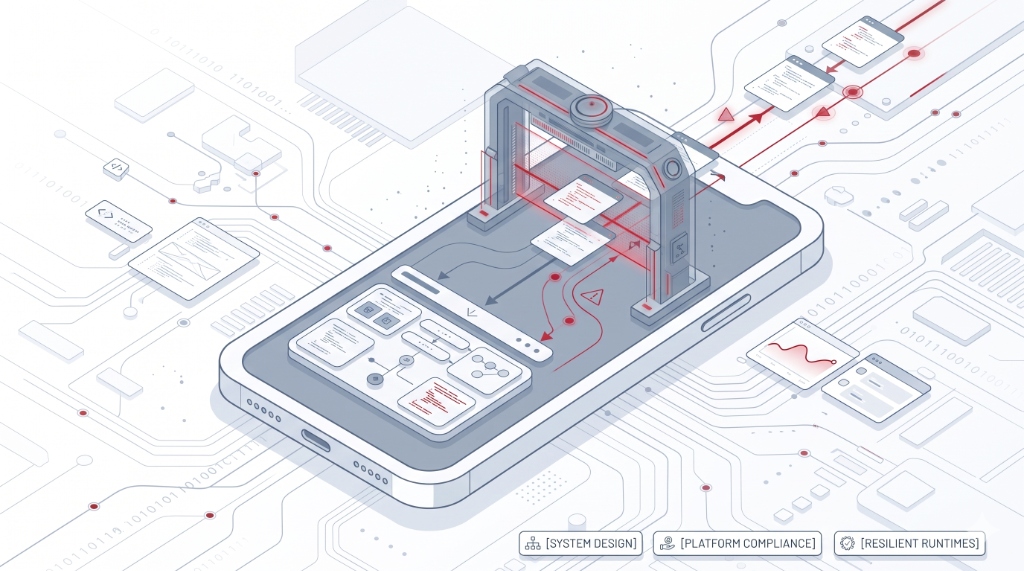
Zero-shot scaffolding can spit out a complete React Native or SwiftUI container with authentication, Supabase bindings, and an AI chat wrapper in twenty minutes. The barrier to generating synthetic syntax has collapsed to near zero.
The barrier to shipping software that survives a hostile runtime—and platform gatekeepers—has not budged.
Two weeks ago, we audited an astrology CRM build intended for professional astrologers to manage natal charts, planetary transit tracking, and recurring consultations. The engineering was clean, typed, and resilient. Yet, the build languished in Apple App Store Connect in an indeterminate, extended review holding pattern.
The cause was not a runtime crash or an undocumented private API flag. The cause was downstream operational collateral damage from the macro-environment: Apple’s App Review queue is choking under a distributed denial-of-service attack driven by thousands of low-effort, LLM-generated clone apps hitting the portal daily.
"When software generation is frictionless, submission volume spikes exponentially. Review teams fortify their perimeters by tightening automated heuristics."
Specifically, review teams have hardened scrutiny around Guideline 4.3 (Design: Spam / Saturated Categories) and Guideline 4.2 (Minimum Functionality). If your application even vaguely resembles a repetitive template or a prompt wrapper, manual reviewers park it in the slow-lane queue for extended forensic checks.
LLMs write syntax with high fluency, but they have zero mechanical sympathy for the operating environments, lifecycle constraints, and platform ecosystem realities your binary must inhabit. As we explored in The Illusion of the Prompt Jockey, confusing text generation with system architecture always defers severe operational debt downstream.
 [ LLM-Accelerated Scaffolding ]
       │
       ▼ (High-Frequency Code Generation)
 ┌─────────────────────────────────────────────────────────────────────────┐
 │ CLIENT LAYER: Synthetic Templates (SwiftUI / React Native)              │
 │ • Generic Nav Stacks       • Chat-Wrapper Forms     • Template WebViews │
 └─────────────────────────────────────────────────────────────────────────┘
       │
       │  Mass Daily Submissions (Queue Flooding)
       ▼
 ┌─────────────────────────────────────────────────────────────────────────┐
 │ APPLE INGESTION GATEKEEPER                                              │
 │                                                                         │
 │  [Automated Static Analysis] ───► Flags 4.2.6 (Template Fingerprints)   │
 │          │                                                              │
 │          ▼ (Pass)                                                       │
 │  [App Review Triage Engine]                                             │
 │          │                                                              │
 │          ├───► [Fast Lane] ─────► True Native APIs / Known Entitlements │
 │          │                                                              │
 │          └───► [Indeterminate Queue: 4.3 Spam / Saturation Sweep]       │
 │                     │                                                   │
 │                     ├───► Astrology, Habit Trackers, Generic LLM Chats  │
 │                     └───► Manual Deep-Scan / Extended Review Latency    │
 └─────────────────────────────────────────────────────────────────────────┘
       │
       ▼ (Downstream Failure Modes)
 [ 14-Day Queue Stall ] ◄────► [ 4.3(a) Outright Rejection ] ◄────► [ Blast Radius ]
The Verification Bottleneck: How Platform Gatekeepers Adapted
Platform ingestion engines run on automated heuristics. Apple and Google receive tens of thousands of binaries weekly, but the emergence of autonomous coding agents and prompt-based app scaffolding tools has multiplied submission volumes tenfold.
The consequence is a classic verification bottleneck. Generating 10,000 lines of syntactically valid TypeScript or Swift takes a prompt engineer ten seconds. Verifying whether that code is novel, stable, respectful of user privacy, and legally compliant requires Apple to dedicate server compute and human reviewer hours.
To protect their store ecosystem from becoming a garbage dump of prompt wrappers, Apple’s triage engine introduces aggressive early-filtering gates. The moment an incoming binary triggers static signatures common to zero-shot scaffolds, it is disqualified from the 24-hour fast lane and routed directly to manual audit limbo.
The Non-Obvious Breakdown: Where AI-Generated Binaries Fail
LLMs are trained to solve isolated token prediction tasks; they do not balance system-wide risk. When developers lean on synthetic generation without senior architectural oversight, specific failure patterns emerge that trigger defensive platform mechanisms:
1. Fingerprint Collision (Guideline 4.2.6 & 4.3)
LLMs have predictable biases in scaffold patterns. They lean heavily on standard navigation stacks, boilerplate state trees, default form layouts, and standard WebView wrappers. To Apple's static analysis tools, thousands of independently submitted apps appear structurally identical.
When an app in a crowded vertical (astrology, horoscope, habit tracking, flashcards, journalers) lands with these signatures, the automated triage flags it under Guideline 4.2.6 (commercial templates) or Guideline 4.3 (Spam). The automated triage drops it straight into the manual quarantine bucket where reviews stall for weeks.
2. The "Thin-Wrapper" Ephemerality Problem
AI generates happy-path logic cleanly, but it omits the structural glue that defines true native utility: offline state synchronization, dynamic cache eviction under high memory pressure, robust CoreData/SQLite WAL-mode configurations, and hardware-level entitlements (haptics, background processing, push notification lifecycle handling).
An app that is just an API wrapper around an external endpoint is treated by gatekeepers as an interactive website dressed in an .ipa container. As we noted in our breakdown of The Hidden Costs of Mobile App Development, failure to account for platform-native constraints is the single fastest way to blow through operational budgets.
3. Missing System Context and Platform Entitlements
When an LLM writes an external integration, it defaults to web paradigms: third-party payment links instead of StoreKit 2 abstractions, ad-hoc tracking instead of explicit App Tracking Transparency (ATT) handling, or raw API calls without required PrivacyInfo.xcprivacy manifest bindings.
A single omitted required-reason API declaration locks your build in a cycle of automated rejections before a human reviewer ever executes your binary. The syntax compiles cleanly, unit tests pass locally, yet the binary is dead on arrival at the gatekeeper.
The Architectural Trade-Off Matrix
A direct technical and operational comparison between unvetted synthetic code, staff-led hybrid engineering, and traditional handcrafted native binaries:
| Dimension | Pure AI-Scaffolded Binaries | Hybrid (AI Code + Staff Systems Design) | Handcrafted Native Monolith |
|---|---|---|---|
| Blast Radius | Critical Risk Automated 4.3/4.2.6 account flags; entire developer accounts risk suspension. |
Isolated & Governed Synthetic logic wrapped inside strictly governed, typed native modules. |
Minimal Full deterministic control over runtime binary, entitlements, and privacy manifests. |
| P99 / Review Latency Tax | 14 to 30+ Days High probability of landing in extended manual spam audit queues. |
24 to 72 Hours Meets deep-native compliance and entitlement criteria on first pass. |
24 to 48 Hours Clean, predictable automated and manual triage pass. |
| Cognitive Load | Deferred Debt Cheap to generate; agonizing to troubleshoot and refactor when stalled. |
Balanced Focus Automation handles repetitive boilerplate; senior engineers govern boundaries. |
High Upfront Significant engineering hours spent writing recurring plumbing and boilerplate. |
| Financial Drag | High Runway Burn Capital wasted in app store review limbo while launch schedules and marketing spend stall. |
Optimized ROI Rapid feature assembly paired with immediate clearance to market. |
High Initial CapEx Slower time-to-market with excessive manual development hours. |
The Pragmatic Heuristic: AI Code vs. Systems Architecture
AI coding tools are not the enemy; uncritical reliance on their structural output is. To navigate platform gatekeepers and ship software that survives production load, adopt three foundational engineering rules:
Rule 1: Use LLMs for In-File Mechanics, Not System Topologies
Let the model write complex regex patterns, generate data-mapping serializers, or implement algorithms you have already specified. Never let it dictate your deployment targets, authentication topologies, offline storage architectures, or device caching layers. System topologies must be designed by human engineers with skin in the game.
Rule 2: The "Airplane Mode" Gatekeeper Test
Before submitting any application to Apple App Store Connect or Google Play Console, cut the device network entirely. Turn on airplane mode and launch the binary.
If your app displays a broken white screen, hangs on the splash screen, or presents unclickable navigation buttons, it is not an application—it is a website in disguise. Human reviewers will flag it immediately under Guideline 4.2 or 4.3. Implement local SQLite caching, on-device compute, and graceful degradation states.
Rule 3: Differentiate at the Platform Boundary
If you operate in a saturated category (CRM, productivity, wellness, astrology), your review clearance depends entirely on hardware-level platform integration.
Implement CoreHaptics for tactile interaction, native background processing tasks for silent data synchronization, WidgetKit extensions for system lock screens, or system file pickers with scoped sandboxing. These provide incontrovertible technical proof to Apple's static analyzers and manual reviewers that the product cannot exist as a simple web-scaffold clone.
Whether choosing between frameworks (see React Native vs Flutter in 2025) or scoping an enterprise system (like a Custom CRM), architecture is what separates disposable syntax from resilient, revenue-generating software.