The Hidden Operational Reality of Running an E-Commerce Store
Launching an online store on platforms like Shopify, WordPress (WooCommerce), Magento, or custom storefronts is just the beginning. Setting up products, designing a beautiful storefront, and running digital ads gets customers to click "Buy Now". But what happens immediately after an order is placed?
Behind every successful e-commerce brand lies an intricate web of post-purchase operational workflows: deducting stock across warehouses, generating GST-compliant tax invoices, booking shipping couriers, tracking parcel dispatches, and handling customer inquiries when shipments are delayed. Most growing store owners quickly discover that their e-commerce platform alone cannot handle these specialized tasks natively.
To bridge the gap, businesses end up assembling a Frankenstein stack of 4 to 6 separate third-party SaaS applications. In this article, we'll examine the different software tools required to manage e-commerce orders, why this multi-app model breaks down at scale, and how a unified custom solution from The Code Art can automate your entire backend without moving a single byte of your existing store data.
Managing orders isn't just about changing an order status from "Pending" to "Fulfilled". It requires synchronizing inventory, tax accounting, courier dispatches, and customer communications simultaneously.
The 4 Core Applications Every E-Commerce Store Needs
1. Inventory Management Software (IMS)
If you sell on your website as well as marketplaces like Amazon, Flipkart, or physical retail, keeping stock numbers synchronized is critical. An inventory management tool tracks stock movements, safety stock margins, purchase orders, and warehouse bin locations.
- Why you need it: To prevent overselling when a surge of orders arrives during flash sales or festival seasons, and to get low-stock automated reorder alerts.
- Common tools: Zoho Inventory, Katana, TradeGecko / QuickBooks Commerce.
2. Accounting & Invoicing Systems
E-commerce accounting in India and globally involves strict tax rules. Every customer order requires a compliant invoice with HSN/SAC codes, state-wise GST calculations (CGST/SGST vs IGST), e-way bills for large orders, and credit notes for returned goods.
- Why you need it: Your e-commerce storefront usually generates simple receipts, not legal accounting tax invoices. You also need to reconcile payment gateway payouts (Razorpay, Stripe) by subtracting gateway transaction fees and accounting for Cash on Delivery (COD) courier settlements.
- Common tools: Tally Prime, Zoho Books, QuickBooks.
3. Parcel Tracker & Shipping Logistics Applications
Once an order is packed, it needs an Air Waybill (AWB) number, a shipping label, and dispatch through courier partners (Delhivery, BlueDart, Bluedart, Shadowfax, etc.). Furthermore, customers expect real-time parcel tracking updates via SMS or WhatsApp.
- Why you need it: To automate courier allocation based on delivery pin codes, schedule warehouse pickups, track non-delivery reports (NDR) for failed delivery attempts, and manage Return to Origin (RTO) expenses.
- Common tools: Shiprocket, Delhivery Direct, ClickPost, AfterShip.
4. Customer Support & Order CRM Software
Over 50% of customer support requests in e-commerce are "WISMO" — Where Is My Order? Support teams need instant visibility into customer order histories, live tracking links, and one-click actions for order cancellations, address corrections, or refund processing.
- Why you need it: To avoid chaotic customer service across WhatsApp, email, and Instagram DMs by centralizing all order-related conversations into a single ticket queue.
- Common tools: Gorgias, Freshdesk, Zendesk, WhatsApp Business API Desks.
The Multi-App Trap: Why Separate Software Apps Create Chaos
While using 5 different SaaS tools might seem fine during your first 20 orders a month, it quickly becomes an operational nightmare when you scale to 50+ orders a day. Here is why the fragmented app model breaks:
- Subscription Creep: Paying $50/month for inventory, $80/month for parcel tracking, $100/month for CRM desk, plus per-order plugin fees adds up to thousands of dollars every year in recurring software costs.
- API Rate Limits & Data Lag: Third-party integrations sync data on polling intervals (every 15 to 30 minutes). If your inventory app lags during a sale, you end up taking orders for items that are already out of stock.
- Disconnected Data & Human Errors: Warehouse staff have to manually copy tracking numbers from the shipping app into the accounting software, or search 3 different tabs just to answer a customer's WhatsApp call.
- Reconciliation Friction: Reconciling COD payments from courier partners against your bank statement and accounting ledgers becomes a multi-day manual exercise every month.
"The cost of managing multiple disconnected SaaS tools isn't just the monthly subscription fee — it's the lost sales from inventory lag, human errors in GST invoicing, and hours spent on manual spreadsheet reconciliation."
The Solution: How The Code Art Builds a Unified E-Commerce Operations Engine
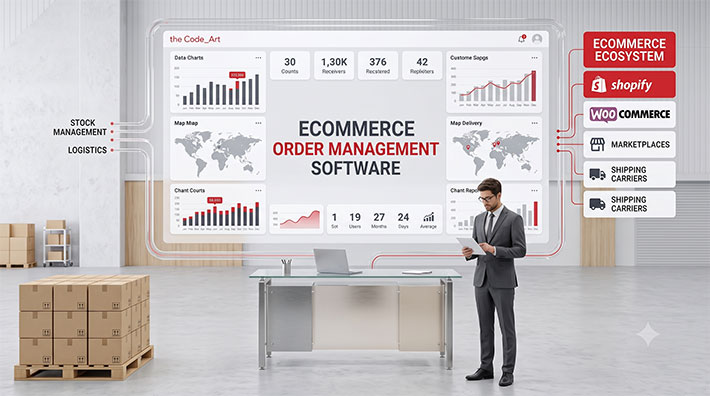
At The Code Art, we help growing D2C brands, WooCommerce stores, and Shopify merchants break free from multi-app chaos. Instead of juggling five different software tools, we build a Unified Custom Solution that combines Inventory Management, Accounting & GST Invoicing, Shipping & Parcel Tracking, and Customer Communication into one single, high-performance web application.
Zero Data Movement Required — "Plug & Automate"
The biggest fear business owners have when considering a custom backend system is the pain of migrating data or re-building their existing online store. With our solution, you don't need to move any data or change your storefront!
- Keep Your Store Front: You continue using your current WordPress / WooCommerce, Shopify, Magento, or custom web platform seamlessly.
- API & Webhook Plug-in: We simply plug our custom management system directly into your e-commerce platform using secure official APIs and instant real-time webhooks.
- Instant Real-Time Automation: The moment a customer clicks "Place Order" on your Shopify or WordPress site, our backend system instantly receives the order payload. In a fraction of a second, it locks inventory, generates the GST invoice, fetches the courier AWB shipping label, and triggers a WhatsApp confirmation to the buyer — automatically!
Key Benefits of a Custom Solution from The Code Art
1. One Single Application for All Operations
Your team logs into one clean, unified admin portal. Your warehouse team sees packing queues, your accounting team sees live GST ledgers and COD settlement reports, and your support team sees live parcel tracking — all in one place.
2. Automated End-to-End Workflows
From automatic courier allocation based on pin-code delivery speed to automated NDR follow-ups on WhatsApp before a parcel gets marked as RTO, repetitive manual tasks are 100% automated.
3. Zero Monthly Per-Order Subscription Fees
Unlike SaaS platforms that charge higher pricing tiers as your order volume grows, a custom solution built by The Code Art belongs to you. You pay no per-order tax, allowing your profit margins to expand as you scale.
4. Built Exactly Around Your Business Logic
Have custom regional distributors? Special B2B wholesale pricing tiers? Custom bundling logic? Multi-warehouse dispatch priorities? Off-the-shelf SaaS apps force you to change your operations to fit their rigid feature set. We build your system around your exact business workflows.
Is It Time to Upgrade to a Unified Order Management Solution?
If your team spends hours every day copy-pasting data between spreadsheets, handling COD delivery discrepancies, or dealing with inventory sync failures, your business has outgrown the fragmented app model.
You don't need to rebuild your website or go through painful database migrations. By plugging a custom operations backend from The Code Art into your existing WordPress or Shopify store, you can automate your entire post-purchase operation overnight.
Ready to streamline your e-commerce operations? Contact the engineering team at The Code Art today for a free strategy consultation and demonstration of how we can unify your store back-office.